I was pleased to be asked to give the Invocation at the Flint Area Congregations Together public meeting with Fr. John Baumann, SJm founder of the PICO National Network who visited Flint to share with us our vision for our future.
I asked those assembled at St. John Vianney Parish to assume the posture of prayer that was the one that spoke most personally to each of us. We're different, and some of us kneel, some sit, some stand. At the same time, because "we're all in this together," I asked that each person find someone's hand to hold. And then I prayed this prayer:
O Thou Whom no person at any time hath seen,
And yet Who, in all the ages and places of the human story,
hath revealed Thyself
in the Mystery of life and the Wonder of creation,
in the Faith kept by generations for their own kith and kin,
in the Love of parents for their children,
in the Hope evidenced by communities of people coming together as we do
to mark a sacred moment,
to experience a transcendent power,
to be a holy people,
be with us, O Divine presence, today, in all your power.
Speak to us as you have in all the prophetic witnesses,
the women and men of the ages
who have looked at the world as it is,
and imagined a world that might be,
Speak to us as have all our teachers,
our Moses, our Socrates,
our Jesus, our Mohammed,
Speak to us as did our brother Mohandas, our sister Dorothy,
our leaders Cesar and Sojourner and Harriet,
our martyrs Harvey and Oscar and Martin,
Enter our hearts, Spirit of Life and Truth,
as you have in all the ages and all the places
so that we may breathe into this place,
our beloved city Flint,
and into this time, this very moment,
a word of promise and hope,
that we may see the powerful community we are,
and know the powerful transformative work we are called to do.
For the sake of our children and our children’s children,
and in the name of all that is holy we pray,
Blessed be. Amen.
Saturday, May 16, 2009


Wednesday, March 11, 2009
Complicated Love
I have long wondered how Unitarian Universalists minister to "my people." Now "my people" is a complicated subset of humanity. Some most readily identify the "my people" among us as middle-aged gay men (yep, I'm one of those!), and gay men have long had a pretty public place among UUs. Especially since the AIDS crisis of the 80s and 90s, many gay men (and those of us who lived through the challenging first decades of AIDS are pretty middle aged now!) have found a place at UU churches where they have been fully integrated.
If "my people" are men, well, of course, men have been running this movement since its inception. Men have also relied heavily on women's participation to raise money for our projects, write our Sunday school curriculums, build all our institutional forms,etc.; but men (as "my people") have been ever present.
But it is working people who have been rather marginalized in our movement. Interestingly, we have long been aware of the challenge of integrating working people into a religious tradition that has long ben part of the ruling class of this country. Friend Street Chapel (1827) was founded in Boston specifically to reach out to the poor and working people who were coming newly into Boston. Similar working-class chapels were established in many cities with large "establishment" churches.
Still, since the suburbanization of our country following World War II, the power of many UU institutions has moved out of the central city (so that the Cleveland OH church is in Shaker Heights, the Lynn MA church is in Swampscott, the Bridgeport CT church is in Fairfield, etc.). I want to find a way to do ministry that was intentionally directed toward serving working class people. In Flint, I have found that some of my most painful and rewarding work has been tending to the grieving of working class families after the loss of mother, father, lover, friend.
Last weekend included two rites of passage for two families. On Saturday afternoon (with a rehearsal on Friday afternoon), I was privileged to officiate at a wedding that was overflowing with joy (and relief!) that this couple had found each other and were ready to go forward in trust and mutual dependence. It was a celebratory afternoon with a delightful evening reception at the Sloan Museum.
On Friday evening, friends of Freda Counelis remembered a mother who recently died in her late 50s. Sitting in Freda's home on Civic Park, looking at piles of photographs and seeing the presence of children's toys and proud clutter, I felt so very much at home. This was as close as I've found in my professional life to the home of my upbringing. And to share with a daughter her feelings for her mom--celebrating the best that her mom was, and her deepest conviction that her mom loved her, loved her, as well as her sense of disappointment at times her mom let her down, and she let her mom down--this was the stuff of a class conscious ministry I to which I aspire.
As the memorial service proceeded, with mom's favorite music, including the karaoke which helped to tie her to a community and to her own son, I was overwhelmed with a notion: that the universalism I preach is about a complicated Love. This complicated Love is, as I might say, eternal and all-conquering; a Love which calls us all into reconciliation and harmony. But it is also a Love which recognizes the aspirations evident in our love. I, personally, always loved my Dad, always wanted to love my Dad, even when the haze of his alcoholism made it hard for him to see me, or for me to see him truly. So often my vision was skewed by my inadequate lenses of resentment, and even my earnest desire to save him, to redeem our relationship, to reform him so that I might be formed as a good son with a good father.
It was a complicated relationship, as our relationships are complicated, and the Love discovered in our lives is a complicated Love. But the universal Love, the eternal and all-conquering Love of our faith, is Love that tolerates the complexity of complicated Love, and gives us a means by which t make things less complicated. In faith, I understand that my Dad is, after death and now in Love's presence, able to live his best Love; and I, too, am able to remember him at his best, to Love him with my best. Eternal and All-Conquering Love leads me to experience a complicated Love not as inferior but as a part of the greater Love.
Likewise, complicated Love lets me see working class people not as inferior (nor superior!) to the middle-class folk who so populate my ministry and around whom so much of Unitarian Universalism is organized. A complicated Love lets me embrace where I am and fully to enter the possibility about which I dream--a multi-class Unitarian Universalism which expresses more completely the fullness of human living and being.
Mornings are dark, again, after the sunrise time was "sprung ahead." Yet here I sit, overwhelmed by this calling, held by a complicated Love which brings me to Flint and sustains me day by day.
Good morning, friends!
If "my people" are men, well, of course, men have been running this movement since its inception. Men have also relied heavily on women's participation to raise money for our projects, write our Sunday school curriculums, build all our institutional forms,etc.; but men (as "my people") have been ever present.
But it is working people who have been rather marginalized in our movement. Interestingly, we have long been aware of the challenge of integrating working people into a religious tradition that has long ben part of the ruling class of this country. Friend Street Chapel (1827) was founded in Boston specifically to reach out to the poor and working people who were coming newly into Boston. Similar working-class chapels were established in many cities with large "establishment" churches.
Still, since the suburbanization of our country following World War II, the power of many UU institutions has moved out of the central city (so that the Cleveland OH church is in Shaker Heights, the Lynn MA church is in Swampscott, the Bridgeport CT church is in Fairfield, etc.). I want to find a way to do ministry that was intentionally directed toward serving working class people. In Flint, I have found that some of my most painful and rewarding work has been tending to the grieving of working class families after the loss of mother, father, lover, friend.
Last weekend included two rites of passage for two families. On Saturday afternoon (with a rehearsal on Friday afternoon), I was privileged to officiate at a wedding that was overflowing with joy (and relief!) that this couple had found each other and were ready to go forward in trust and mutual dependence. It was a celebratory afternoon with a delightful evening reception at the Sloan Museum.
On Friday evening, friends of Freda Counelis remembered a mother who recently died in her late 50s. Sitting in Freda's home on Civic Park, looking at piles of photographs and seeing the presence of children's toys and proud clutter, I felt so very much at home. This was as close as I've found in my professional life to the home of my upbringing. And to share with a daughter her feelings for her mom--celebrating the best that her mom was, and her deepest conviction that her mom loved her, loved her, as well as her sense of disappointment at times her mom let her down, and she let her mom down--this was the stuff of a class conscious ministry I to which I aspire.
As the memorial service proceeded, with mom's favorite music, including the karaoke which helped to tie her to a community and to her own son, I was overwhelmed with a notion: that the universalism I preach is about a complicated Love. This complicated Love is, as I might say, eternal and all-conquering; a Love which calls us all into reconciliation and harmony. But it is also a Love which recognizes the aspirations evident in our love. I, personally, always loved my Dad, always wanted to love my Dad, even when the haze of his alcoholism made it hard for him to see me, or for me to see him truly. So often my vision was skewed by my inadequate lenses of resentment, and even my earnest desire to save him, to redeem our relationship, to reform him so that I might be formed as a good son with a good father.
It was a complicated relationship, as our relationships are complicated, and the Love discovered in our lives is a complicated Love. But the universal Love, the eternal and all-conquering Love of our faith, is Love that tolerates the complexity of complicated Love, and gives us a means by which t make things less complicated. In faith, I understand that my Dad is, after death and now in Love's presence, able to live his best Love; and I, too, am able to remember him at his best, to Love him with my best. Eternal and All-Conquering Love leads me to experience a complicated Love not as inferior but as a part of the greater Love.
Likewise, complicated Love lets me see working class people not as inferior (nor superior!) to the middle-class folk who so populate my ministry and around whom so much of Unitarian Universalism is organized. A complicated Love lets me embrace where I am and fully to enter the possibility about which I dream--a multi-class Unitarian Universalism which expresses more completely the fullness of human living and being.
Mornings are dark, again, after the sunrise time was "sprung ahead." Yet here I sit, overwhelmed by this calling, held by a complicated Love which brings me to Flint and sustains me day by day.
Good morning, friends!
Wednesday, March 4, 2009
Millard Fillmore and Sissy Lifelines

I couldn't believe the side comment made during the trivia game played at church on Sunday night. The host mocked us by complaining that the game was taking far too long because people were relying on "those sissy lifelines." Sissy? Sissy?!? I couldn't believe my ears!
Some of us wear the term "sissy" as a badge of honor. Personally I can choose "sissy" for myself to undo the years of bully-terror as a child when such name calling was accompanied by the threat of physical harm. I don't remember being physically beaten as a child--the authentic fag-bashing would come much later--but I do remember one day after school being in tears at threats by a neighbor and ending in my mother's closet crying my heart out. Now THAT'S a sissy boy!
I was astonished to hear the term used, and I expect the host will never live it down. (Her partner sat at the "experts" table with her mouth agape. "Gender bashing! Gender bashing!" some of the lesbians cried out.)
But of the content of the game itself, I was amused at some of the answers (can't figure how the establishment of the American Unitarian Association, which happened in 1825, was cited as beginning in the 1740s) and became quiet and thoughtful about others. In particular, the game needed to cite the Unitarian Presidents of the United States, and I wrestle with that badge of honor.
John Adams, of course, had modernist ideas about religion. So did Thomas Jefferson. Neither was a member of a Unitarian church because there weren't any, although the arguments between orthodox and liberal ministers in Massachusetts were leading toward the formal adoption of unitarian theology in the next generation. In John Quincy Adams's day, the parish to which his family belonged did, indeed, become a Unitarian congregation. Millard Fillmore was a charter member of the Unitarian Church in Buffalo, and William Howard Taft was a member of the First Unitarian Church in Cincinnati.
I remember hope being expressed at an anti-oppression workshop once, "If only we can grow to the place where we have a Unitarian Universalist President of the country, we'll finally be able to end oppression." Huh? We've already had a few chances at that, and what did we get? The man who signed the Fugitive Slave Law into effect.
I'm no Millard Fillmore expert, but I understand that he understood he was to serve as president for the entire nation. He was against the extension of slavery as our country grew, but felt that refusing to enforce the laws of our constituent states would lead to division. To reject the Fugitive Slave Act--passed by Congress--would be an abrogation of his essential role as President of all the states. For Fillmore, signing a law he did not agree with was an act of political compromise. (For more information on Millard Fillmore go to the Famous UUs pages.)
As Barack Obama seeks to lead us, now, I wonder what he will need to do as an act of compromise which will disturb some of us who know ourselves as liberals and progressives. The venom out there, calling every act of "common weal" a step toward socialism, is quite deadly. The legislation making its way through Congress is replete with compromise, and none of us is certain that the expensive investments that are being made will do the trick at averting economic catastrophe. Still, I can imagine "perfect" legislation that will never be passed competing with the "good" that is possible.
Well! Time to get to the treadmill of the gym before the delightful treadmill of my work and my vocation. Good morning!
Tuesday, March 3, 2009
Still March . . .

As I watched the sun rise this morning (at 7:07, according to the almanac), I has the sense that we're coming around to "normal" daylight again. When the alarm goes off at 6:45, I have a sense that I am at the break of dawn, even though it is a little skewed by the good choice I made last summer to move into the big bedroom on the west side of the house. So as I sit at the computer in the east-facing "boys' room," (I'll tell you later. Remind me.), the colors of the sky are changing more completely than they are in the view from my bed. Finally, not to be bumping around in the dark!
But then I look at my planner, and see that Sunday will be the first day of Eastern Daylight Time this year. March 8th? I mean, come on! March 8? Sunrise goes back to being at 8 o'clock? Help!
Okay, okay, I know I'll get over it. But what a drag! It will mean a little more light at the end of the day, but we haven't even hit the equinox yet, and we'll be trading some afternoon light for a morning that is too too dark.
That's what I think.
March is a time for some traditions for me, including the month when I repot my house plants. I think I'm going to get a couple larger copper pots to the plants in the sun room (which grew into larger pots last year very quickly. I think the room can handle them, and they can use a little room. (Maybe I'll even post their pictures on the first day of sprig! Note to self . . .)
I am wandering in the yard each day talking to the plants and encouraging them to wake up. (The neighbors already know I'm crazy, and are just happy that there is one less vacant house in the neighborhood.) The tufts of thyme that I planned on making a little border between the lingon and dill and the lawn look like they are ready to grow into the role I chose for them--thank you, thyme!
Which brings me to the Pete Seeger song that inhabits my heart lately (don't know why).
Old devil time, I'm gonna fool you now,
Old devil time, you'd like to bring me down,
But when I'm feeling low, my lovers gather 'round
And help me rise to fight you one more time.
Old devil fear, you with your icy hand,
Old devil fear, you'd like to freeze me cold
But when I'm sore afraid, my lovers gather 'round
And help me rise to fight you one more time.
Old devil hate, I knew you long ago
Before I learned the poison in your breath
Now when I hear your lies, my lovers gather 'round
And help me rise to fight you one more time.
No storm or fire can ever beat us down,
No wind that blows but carries us further on.
And you who fear, oh lovers, gather 'round
And we can rise to sing it one more time.
Good morning!
Sunday, March 1, 2009
March already? It can't be!
I have been getting up a little early this week to put some attention to my days. I'm not sure exactly what that's about, except to say that the discipline of keeping Lent has been a part of my life-pattern of the past decade.
I realized after I left seminary and began serving a humanist congregation that I needed to be intentional about my own spiritual practice (duh!). The pattern that I had developed over time was largely seasonal--a week at Ferry Beach in the summer, a week in Montreal in the winter (visiting cultural institutions, having time on my own, and a lot of sitting in big fancy churches where I was invisible), some time in retreat with the Cowley boys, or with UUMA collegaues, or the UCC pastor's study retreat in Springfield, or even the Advent study with Bishop Stendahl. I didn't have a pattern of devotion in my church, and needed to create one for myself.
My therapist Dr. O'Donnell had encouraged a Lenten practice to get me out of winter hibernation (that sounds like a redundancy), and so I began a pattern of study and prayer, including a little more morning time. (That's even the reason I started this blog a couple of years ago--more intentional morning time to "tame" my monkey-mind.)
But this Lenten practice is not about taming anything, rather, I hope to establish a "pattern" of my own in a life that so often is caught in other people's lives' patterns. And then there is this blog, a pattern of patter(?).
My sister Carol encouraged me to spend the time to write. And so I have . . . although it seems it is about "nothing."
And yet, as I sit here, O know where my mind is going: to a Sunday service in a few hours, where Melanie Morrison will preach, and where I will be moved; to a relationship building campaign training that I hope will be productive and reflective; to the Hellobores which are in the back yard and which I hope will produce this spring their first flowers since transplantation; and to my aching back which so wants me to take the morning off and go to the gym.
Which I can't, which I won't. But still, paying just a little attention to how I'm doing in my body gets me at least a little in touch with the world. And so I'll do a little stretching before hitting the showers . . .
The sun is a few minutes away, the air quite clear, the temperature a tiny bit brisk, and I'm thinking of family and friends and, of course, my congregation and my call.
Good morning.
Thursday, February 19, 2009
In the drizzle, inspiration
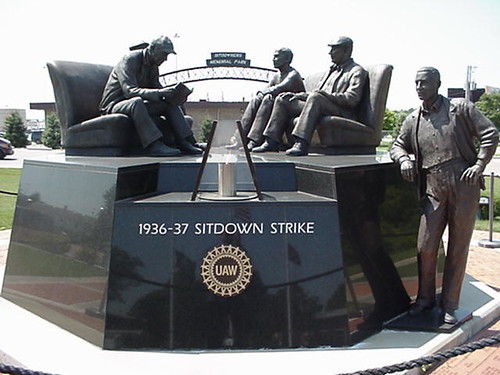
What burns in this chalice, this sacred bowl, this cup o'erflowing with welcome and promise? What means this religion of ours, this attempt of humans, temporal and finite, to express the eternal and infinite? How do we discover the larger truths out of our smaller selves? How shape we symbols which inspire?
I stood, last night, in drizzle-rain, stood near UAW Region 1-C. We were leaving the hall, friends of a fallen comrade, leaving a time when we sought to be together to comfort brother and son after death of sister and mother. We had had a moment together to celebrate one of our own, and to accept the challenges of keepin' on without her in our midst.
I stood in the drizzle-rain and walked on the slick bricks around the Sitdowners Memorial. I saw there all those who struggled for human progress in all the ways we have and do. My dad was present in my ruminations, telling me and my brothers that we weren't welcome around the shop when he was on strike. "We get rough sometimes," he said, and he didn't want to scare us if the men on the picket line felt they needed to jostle (or overturn?) a car.
I felt the presence of Mother Jones, too Mother whose grave I discovered on the ride from Flint to St. Louis a few years ago. Imagined the friends from 'round the world whose names I had seen on the visitor register that day--people I hadn't spoken to in years, but whose visit to that memorial was held closely in the little daily register barely kept safe from the elements.
I stood a few years ago before the Rosa Luxemburg-Karl Liebknecht memorial in Berlin. A flame burns there, too, and the stones bear a motto: "The Dead Remind Us." That flame reminds me of all those who have struggled that I might enjoy the prosperity and freedom that I so take for granted.
"If I stood out in the rain-night, my only light a candle, a million miles away, would you lay down your fire as I lift mine? Will you not kill again?" Cindy Kallet sees in tiny fires of all our candlelit vigils the possibility of the end of all the fires of war.
And I see, now, in the Sitdowners' Flame something of the possibility, for all of us, of a day when we all might know work that bears dignity, leisure that restores, community that heals and builds, creativity that liberates imagination unto the infinite.
I stood in the drizzle-rain, and was blessed.
Wednesday, February 11, 2009
Long Time No . . .
Chris Monk gave me a hard time the other night at a Worship Team meeting. Wondered why I had been so silent for so long. I don't think I can answer that right away, but I guess that I have to be honest with myself and say that some events from about a year ago still fill me with anxiety, and especially about where I may say what with what level of safety assured. (I mean, sometimes no matter what I say or don't say, things blow up.)
That being (un)said, I want to take advantage of my own thoughts about what this year might entail at our church in Flint.
I wanted to share with our program people in worship and music, lifespan learning and membership some ideas about how I wanted to shape the "liturgical year." ("Liturgy" is about the work of the "li" people, that is, the laity. So it is important that they have a clue where I think we/they ought to take their/our work. Right?!)
I wanted to follow the patterns of the natural year plus the cultural year. So the fall was the time of ingathering and celebration, and also a time to say that, about last spring and summers conflicts, it was now time to make amends.
September--hospitality theme
October--atonement theme
November--gratitude theme
Winter begins a time of bundling, of gathering around the hearth and drawing close to each other. It becomes a place to share the "deep thoughts" of a community, and, when walking under the clear winter sky when the cloud cover is so dispersed, to look at those stars and to imagine what it means to be "the stuff of stars." We also mark the cultural holidays of the season, and anticipate spring.
December--embodiment theme
January--struggle theme
February--forgiveness theme
March--transformation theme
Finally, we rejoice as nature awakens, as sap runs and flowers emerge, as snow melts away and water rushes to green us. We receive energy and share energy and look at things with anticipation of fruitfulness and favor.
April--regeneration theme
May--engagement theme
June--hope theme
The summer then becomes a time of potpourri, a variety of experiences with people coming and going. I try very intentionally not to draw a distinction between "minister's services" and "lay services" because I think I have vocational and professional responsibility for all of them, and, from my point of view, all services are lay services (again, the work of the laity). But, in truth, I am only present for about half the services in the summer, and it becomes a time of greater variety even as the congregation itself has more variety as people leave on vacations, go to the places "up north," etc.
Projecting forward a year has meant that I am more conscious as I study, week by week, of materials which will be part of the future Sunday story of this congregation. I hope it is making me a better minister. It certainly has been a way for me to raise the bar of expectations for myself. I feel far more powerful.
Good to be writing again. I'll try to keep this up.
Subscribe to:
Posts (Atom)